International Student Statistics 2026: A Data Roundup
Around 6.9 million students now study outside their home country, and forecasts point to roughly 9 million by 2030.
Around 6.9 million students now study outside their home country, and forecasts point to roughly 9 million by 2030. The headline for 2026: every Big Four destination is now tightening or shrinking, UK demand is strong but visa grants are falling, and Japan, Germany and Dubai are taking share.
1. The global picture: growth continues, but the map is being redrawn
- 6.9 million students were studying outside their home country in the latest count, a figure that has tripled since 2000 (UNESCO, 2023 data published June 2025).
- Roughly 9 million students are forecast to be internationally mobile by 2030, with QS, HolonIQ and Navitas projections converging on the same figure (QS analysis via ICEF Monitor, July 2025).
- The “Big Four” destinations (US, UK, Australia, Canada) are projected to hold only about a third of global mobility by 2030, as Europe, Asia and the Middle East gain share (QS via ICEF Monitor).
The implication is clear. Growth is no longer a rising tide that lifts every destination. Recruitment strategy now determines who captures it.
2. The Big Four are diverging, not declining together
🇬🇧 United Kingdom: demand is strong, but the visa gate is tightening
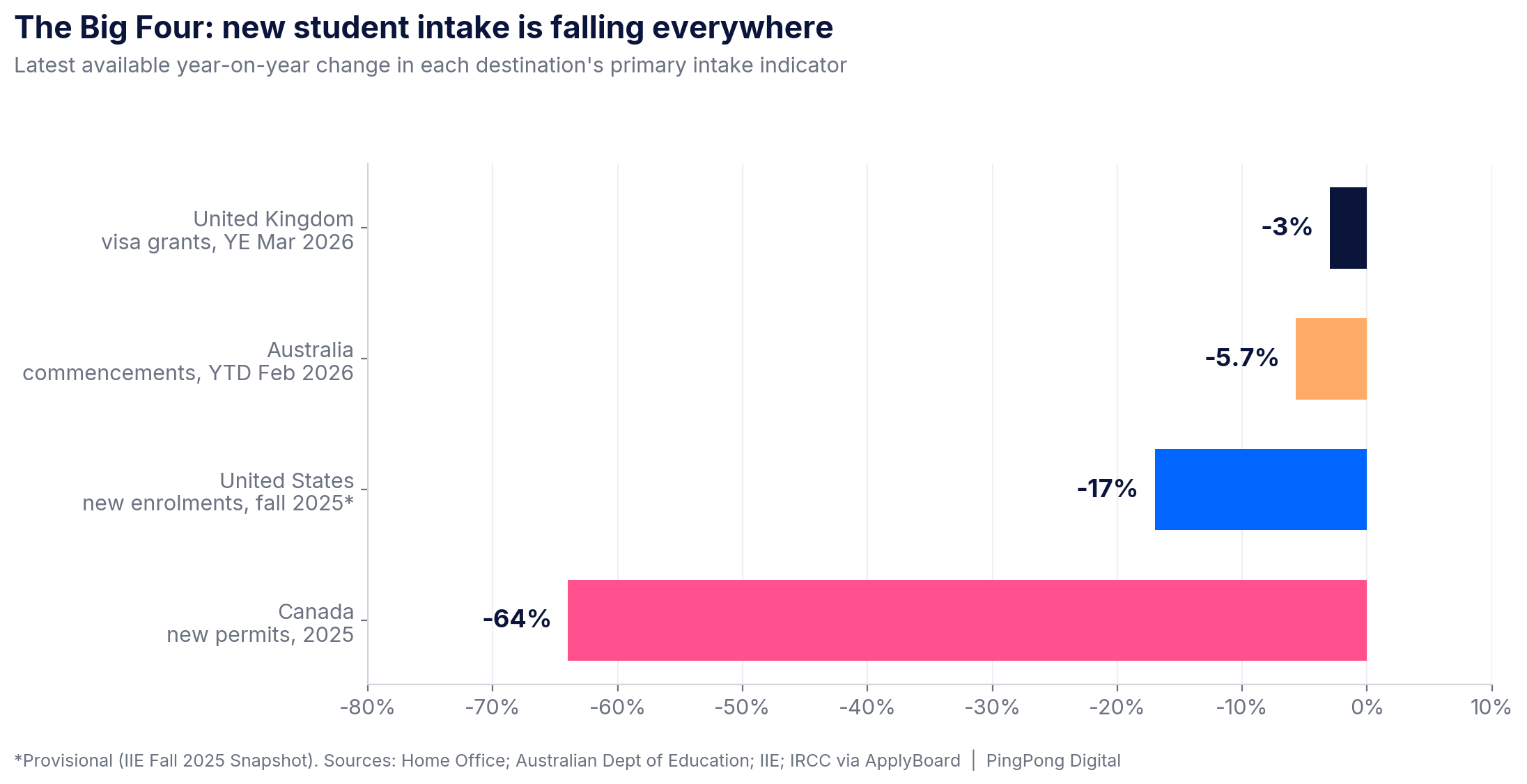
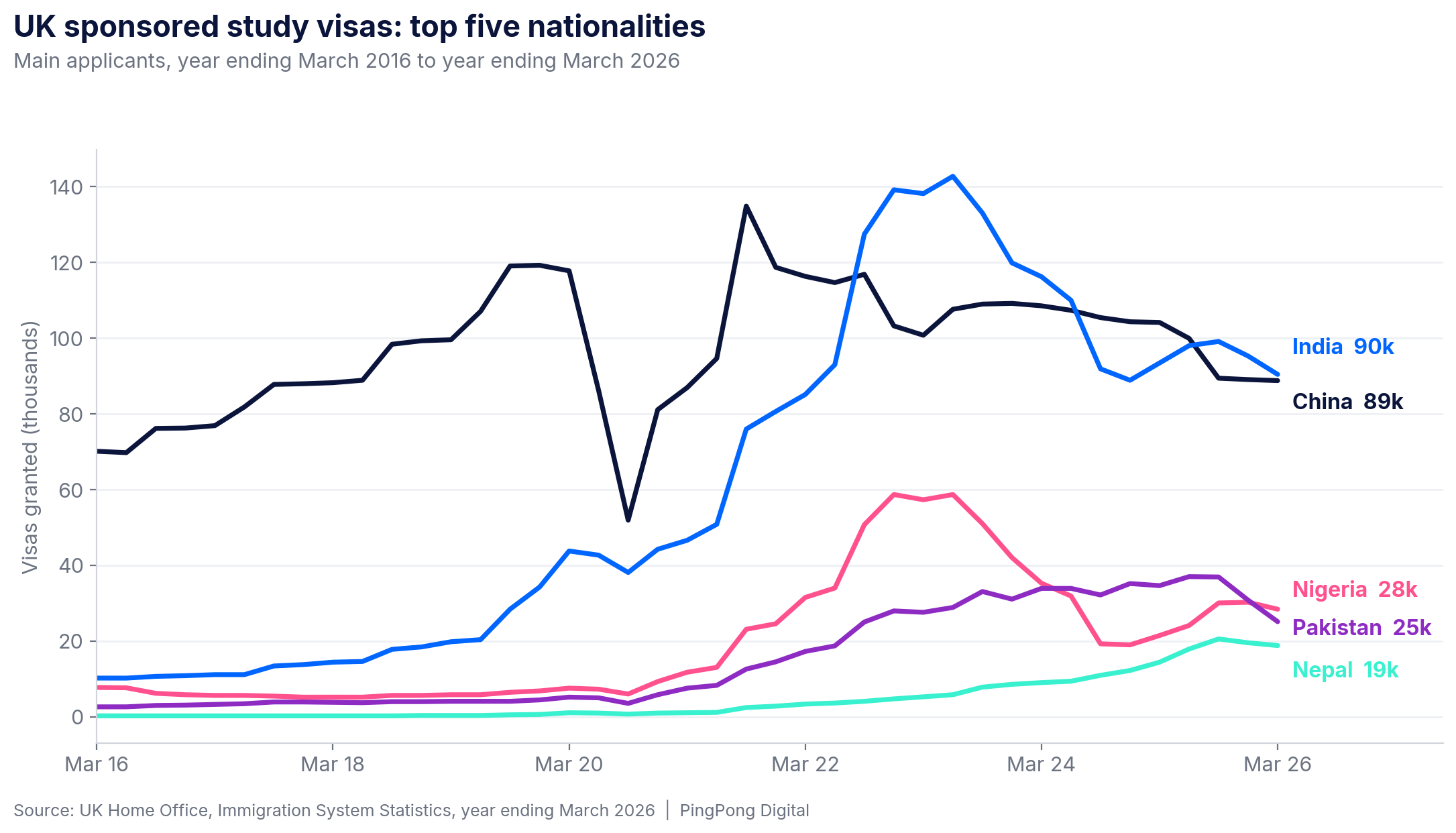
- 409,954 sponsored study visas were granted in the year ending March 2026, down 3% year on year and 37% below the mid-2023 peak (UK Home Office, May 2026).
- India (90,425) and China (88,776) each accounted for 23% of main-applicant visas, with China down 15%. Nigeria grew 33% to 28,405 (UK Home Office, May 2026).
- Q1 2026 brought a sharp squeeze: visa grants fell 32%, and application withdrawals exceeded refusals for the first time in around 20 years, with Pakistani applicants making up 43% of withdrawals. From 1 June 2026 institutions must keep refusal rates under 5% (ICEF Monitor, June 2026).
- 124,830 international applicants applied through UCAS by the January 2026 deadline, up 5.1%, with Chinese applicants up 10% to 34,380 (UCAS, February 2026). Demand is holding; conversion to visas is the new battleground.
- The lagging indicator: 685,565 international students were recorded in 2024/25, down 6.1%, with postgraduate taught numbers down 12.7% (HESA, January 2026).
🇺🇸 United States: record headcount, weakening pipeline
- 1,177,766 international students studied at US institutions in 2024/25, an all-time record and up 5% (IIE Open Doors, November 2025).
- But new enrolments fell 7% in fall 2024, and the provisional Fall 2025 Snapshot of 825+ institutions shows new enrolments down a further 17% (IIE; full 2025/26 data due November 2026).
- India is now the largest source market at 363,019 students (+10%); China fell 4% to 265,919 (IIE Open Doors). But the trend is reversing at the application stage: only 39% of institutions report stable or rising applications from India for 2026/27, the sharpest deterioration of any market, while China’s position improved year on year (IIE Spring 2026 Snapshot).
- The freshest signal, published July 2026: 63% of 585 surveyed US institutions forecast a decline in international student numbers for 2026/27, with only 11% anticipating increases. Among those expecting declines, 92% cite visa application barriers and 77% cite students choosing another country (IIE Spring 2026 Snapshot, July 2026).
- Yet 82% of US institutions still consider international recruitment a priority for 2026/27 (IIE Spring 2026 Snapshot). The demand for solutions is not going away; the competition for a shrinking pipeline is intensifying.
🇨🇦 Canada: the cautionary tale but opportunities remain
- 75,372 new post-secondary study permits were approved in 2025, down 64% year on year and 18% below the 2020 pandemic low. The approval rate fell to 35.7% (IRCC data via ApplyBoard and ICEF Monitor, April 2026).
- Canada’s total foreign enrolment has fallen by nearly 300,000 students in two years (ICEF Monitor, February 2026).
- The 2026 cap cuts study permit application spaces to 309,670, a further 7% reduction, though master’s and doctoral applicants at public institutions are exempt from provincial attestation letters from 1 January 2026 (IRCC).
🇦🇺 Australia: the decline has arrived in the 2026 data
- 622,043 international students were in Australia as of February 2026, down 7.7% year on year, with commencements down 5.7% and ELICOS enrolments down 31% (Australian Department of Education, YTD February 2026; analysis by ICEF Monitor, April 2026).
- Across full-year 2025, new commencements fell 15% while total numbers held broadly flat (Department of Education via ICEF Monitor, March 2026).
- From 1 July 2026 the non-refundable student visa fee rises again to AU$2,500, up 25% in a year and 285% since 2022. Comparators: around AU$775 in the US, AU$935 in the UK and AU$240 in Canada (ICEF Monitor, July 2026).
3. Source markets: diversification is now essential
- India: more than 1.8 million Indian students are abroad across 153 countries, but 2025 brought the first decline in three years, down 5.7% (Indian Ministry of External Affairs, December 2025, PDF).
Our take: India’s US numbers are flattered by OPT. Post-study work participation, up 21%, accounted for most of the overall US increase (ICEF Monitor analysis of Open Doors) while new Indian commencements and applications fall. Unlike Canada’s vocational-college boom, this cohort is at universities, mostly in STEM master’s degrees. But the structure rhymes: it is employment-pathway demand, tied to OPT and H-1B prospects, and issuances fell 36% in summer 2025 with OPT uncertainty cited as a factor (ICEF Monitor, March 2026). Institutions overweight in Indian graduate demand should treat diversification as urgent, and messaging to Indian students should lead with career outcomes and visa certainty.
- China: a mixed picture. Numbers fell in the US at -4% (IIE), on UK visas at -15% (Home Office) and in the Netherlands at -28% (Nuffic), yet UCAS applicants for 2026 entry rose 10% (UCAS). China remains essential, and volatile.
- The growth belt: Nigeria grew 33% on UK study visas in the year to March 2026 (Home Office, May 2026), following surges from Bangladesh (+71%) and Nepal (+60%) in the year to December 2025 (Home Office, February 2026), while Vietnam, Colombia and Peru all hit record totals in the US (IIE).
- Central Asia: Kazakhstan now hosts 35,075 international students from 88 countries, up 11% (The Astana Times, December 2025), and has set a target of 150,000 by 2029 as it builds regional hub status (ICEF Monitor, October 2025).
Universities that depended on one or two markets are the most exposed institutions in the sector. The winners in 2026/27 will be those already building presence in South Asia beyond India, Southeast Asia, Central Asia and Latin America.
4. The challengers: where displaced demand is going
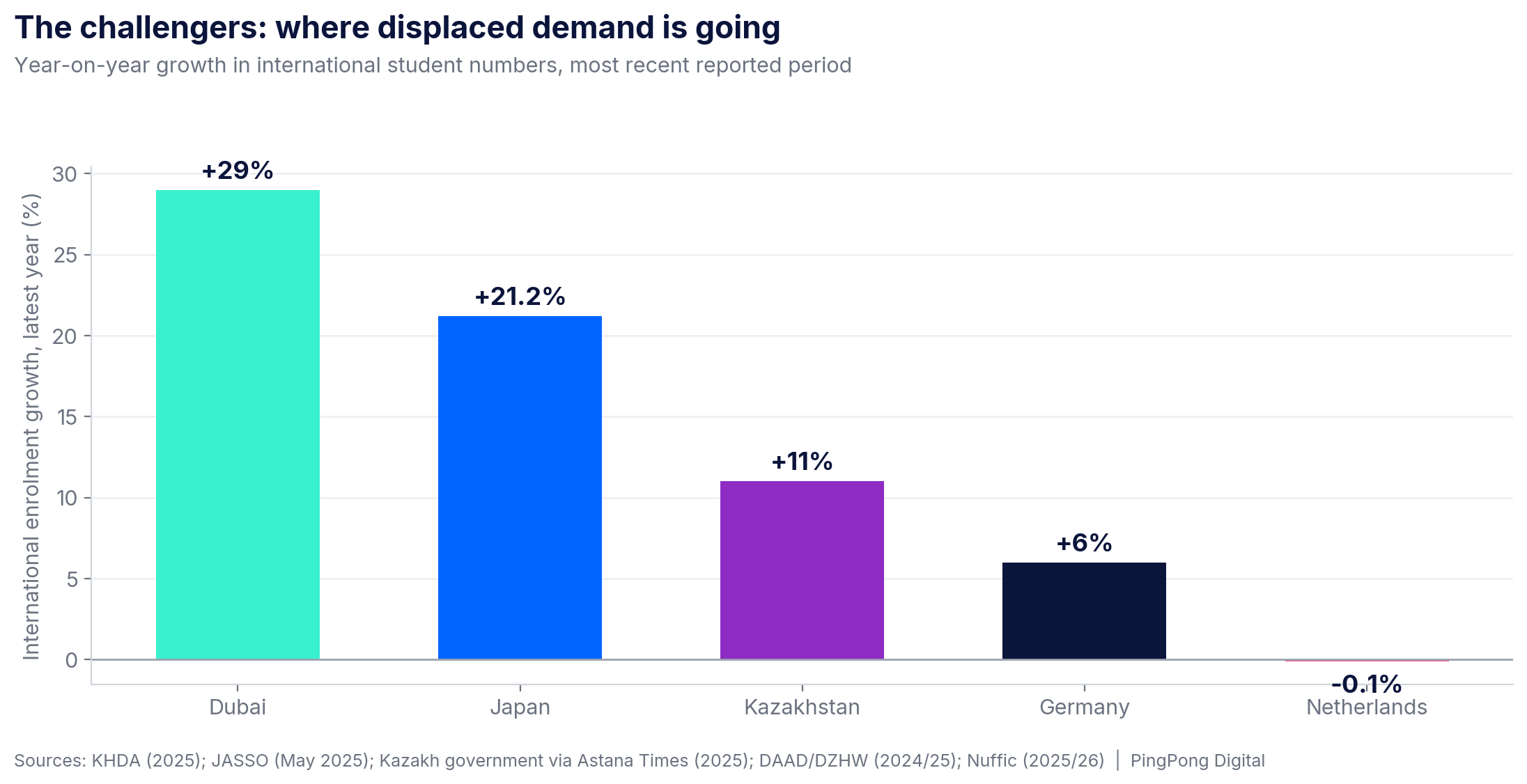
- Japan: a record 408,069 international students as of May 2025, up 21.2%, reaching its 400,000 target eight years early (JASSO) but most of these students are not at the UG or PG/Grad level, something the Japanese government is working to change.
- Germany: around 402,000 international students in 2024/25, up roughly 6%, with a record 116,600 international first-years. India is the top source market (DAAD/DZHW).
- Dubai: international enrolment in private higher education grew 29% in 2025 and now makes up 35% of the sector (KHDA).
- Netherlands: a counterpoint. The first recorded decline in foreign enrolment, down marginally to 129,764 in 2025/26 after anti-internationalisation measures (Nuffic, June 2026). Europe is not uniformly gaining.
5. How students are finding you: GEO and AI search arrive
- 17% of newly enrolled international students used AI tools such as ChatGPT in their initial university search, and 96% of those said AI guidance met or exceeded traditional sources (INTO University Partnerships survey of 1,622 students, via ICEF Monitor, January 2026).
- Adoption is highest in East and Southeast Asia: around 30% in South Korea and the Philippines, 25% in Vietnam and 21% in mainland China (INTO via ICEF Monitor).
- What students ask AI about: rankings and reputation (61%), programme details (39%), and career outcomes (34%) (INTO via ICEF Monitor).
- The direction of travel is unambiguous: 95% of UK undergraduates now use AI in some form, and 37% lean towards AI over traditional information sources, versus 33% the other way (HEPI/Kortext Student Generative AI Survey 2026, March 2026).
- Sector analysis now describes student discovery starting inside AI-generated answers rather than search results pages, with a small set of institutions dominating AI answers and aggregators such as UCAS and Prospects shaping which universities AI includes (HEPI, June 2026).
If your institution’s content is not being cited by AI assistants when students ask these questions, you are invisible at the top of the funnel. This is why generative engine optimisation (GEO), the discipline of earning visibility in AI search, now sits alongside SEO in serious recruitment strategies.
What this means for recruitment teams
Diversify deliberately. The growth is in Bangladesh, Nepal, Nigeria, Vietnam, Central Asia and Latin America. Plan country-level campaigns, not regional afterthoughts.
Treat policy as a planning input. Canada shows how quickly a market can close; the UK shows that recovering demand can still be choked at the visa stage. Build scenarios for visa policy in every destination you operate in.
Invest in GEO (AI search optimisation) now. A meaningful share of your next intake will shortlist universities through AI assistants. Measure whether AI tools mention and cite you, and structure content so they can.
Want to know whether AI assistants mention your institution when students ask? PingPong Digital runs GEO (AI search) visibility audits for universities. Contact us
Frequently asked questions
- How many international students are there worldwide in 2026?
The latest count puts internationally mobile students at 6.9 million (UNESCO), and forecasts from QS, HolonIQ and Navitas converge on roughly 9 million by 2030 (ICEF Monitor). - Which country hosts the most international students?
The United States, with a record 1,177,766 international students in 2024/25 (IIE Open Doors), although new enrolments are falling. - Is the UK international student market recovering?
Demand is recovering but conversion is not. UCAS international applicants for 2026 entry rose 5.1% (UCAS), yet study visa grants fell 3% in the year to March 2026 (Home Office) and dropped 32% in Q1 2026 as compliance rules tightened (ICEF Monitor). - What is the fastest-growing destination for international students?
Japan, where international enrolment grew 21.2% to a record 408,069 in 2025 (JASSO). Dubai grew 29% from a smaller base (KHDA). - Do students really use AI search to choose universities?
Yes. In a 1,622-student survey published in January 2026, 17% of newly enrolled international students used AI tools in their initial search, and 96% of those rated the guidance as good as or better than traditional sources (INTO via ICEF Monitor). This is why universities are adding GEO (generative engine optimisation) to their recruitment marketing.


